
👋 Do you want to know what types of 3D printers are available? You’ve come to the right place!
Each technology has different applications, different prices and different target audiences. That’s why we’ve put them all together in this article and we’ll explain what each one is for.
If you want to jump to a particular technology (FDM, resin, SLS… there’s a lot!) you can use the article summary below to see them all at a glance. If you prefer to absorb everything, read on and immerse yourself in the world of 3D printing technologies with us 👇
📖 What do you want to read?
✅ FDM filament printing, the most popular option
To get started, you can find printers that use FDM (Fused Deposition Modeling) technology. FDM is a term registered by Stratasys, the company that invented this technology, so some circles also use the acronym FFF (Fused Filament Fabrication).
After many years controlled exclusively by Stratasys, in 2004 the RepRap movement began to create and release free FDM printers, which are the ones that have caused the desktop 3D printing boom. Thanks to that today we can enjoy such a variety of desktop printers so cheaply available:
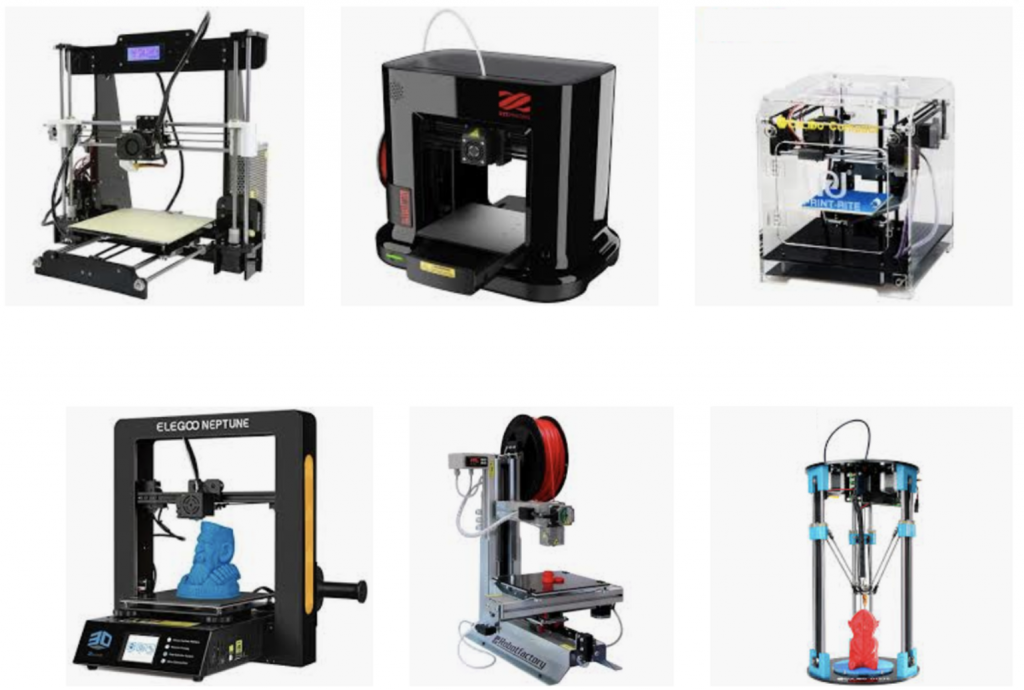
How do these printers work? As their name suggests, they use a thermoplastic filament, melt it and extrude it through a nozzle, to deposit the part layer by layer, from bottom to top.
💪 What are the advantages of FDM printers?
FDM 3D printers are the cheapest, most accessible and popular of all the different types of printers out there. In addition they are the simplest machines and there is a lot of information online about them, so it is the most suitable technology for those who want to start in 3D printing.
All these advantages make it the ideal printer for companies, offices, workshops, SMEs in general and are also very suitable for private users.
🤔 What types of FDM 3D printers can we find?
Within this category, you can find several subcategories that you must take into account when purchasing a 3D printer.
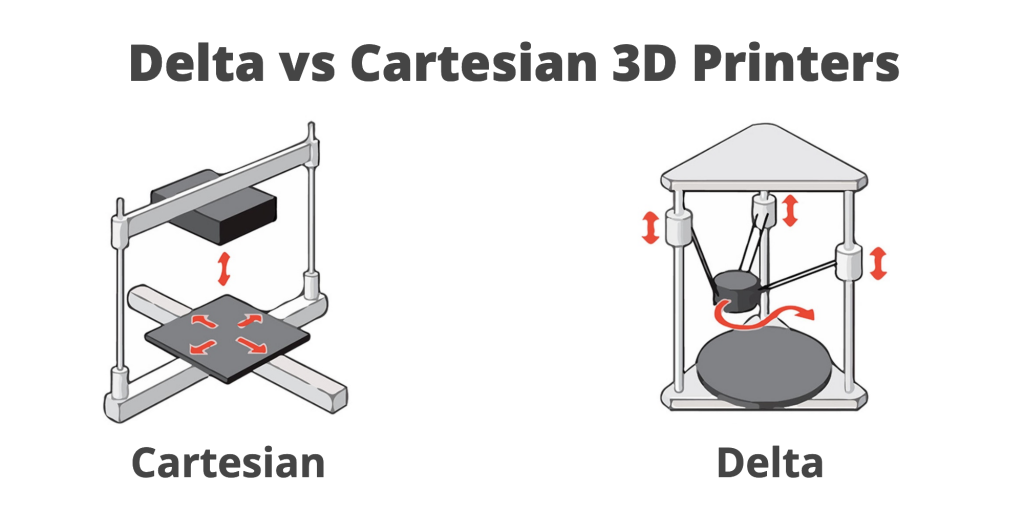
- Cartesian: uses the Cartesian axis X-Y-Z, with three axes perpendicular to each other. Its main benefit lies in its ease of use, and being the type of printer with the simplest mechanics, they are the easiest to calibrate and for correcting errors that may arise during use.
- Delta: Delta robots have a static circular printing bed. Their 3 articulated arms in different heights move up and down to get the job done. Their printing quality, higher speed, precision and no backlash reaction –as their straps don’t stop tightening– stand out.
💵 How much does it cost to print in FDM?
3D filament printing parts are the most economical to produce, suitable for prototypes, short series and for large format 3D printing.
The cost of filament printing is the lowest of all the technologies we are going to talk about, so if you are curious about this topic you can go to our article on 3D printing prices or ask us directly for a quote to tell you how much your project costs:
✅ Stereolithography, impeccable finishing and detail
Stereolithography (what are commonly called resin printers) is the oldest 3D printing technology. They are the pioneering printers, but have not stopped advancing and to this day remain one of the most used and versatile.
It works with a tank of photopolymer resin that is solidified layer by layer with UV light, and the part grows on the printer platform. The video we have put in this section can help you understand the process.
The biggest advantage of stereolithography, especially when compared to filament printers, is that we can get high quality parts from them without the need for post-processing. It is a technology that allows us to obtain great finishes and details for pieces such as prototypes, figures, complex or small parts.
In addition to their great finishing, stereolithography printers have long been used in industry and the dental sector, so they have advanced materials to print parts with high added value: biocompatible materials, sterilizable, resistant to high temperatures, flexible, transparent, optical, etc. … It is the technology with the most high-performance materials available.
They have the disadvantage that it is necessary to wash and cure the pieces so that they harden after printing, which requires handling the resins and having a washing and curing station. In addition, the resin stains everything that comes into contact with it and has a strong smell, so it is usually necessary to have a ventilated and separate space for these printers.
✅ DLP, more resin 3D printers!
DLP stands for Digital Light Processing. This technology is the twin sister of stereolithography; the difference is the ultraviolet light source: a projector that exposes the whole layer at once over the resin tank.
Very similar are LCD screen printers (MSLA), where a screen acts as a mask over an LED light source. They are the ones that have brought resin 3D printing to a domestic audience: they work with the same kind of materials and are easier to manufacture, so today there are many low-cost resin printers that anyone can buy.
They have the same advantages as all other resin printers, great finishing and an ecosystem of advanced materials available for professional users. Like stereolithography, they require a separate space to clean and cure parts.
✅ SLS, nylon powder parts
This technology is known as Selective Laser Sintering. It works similarly to stereolithography, but the printer laser is used to sinter (fuse but not melt) a bed of polymer powder, which is usually nylon (polyamide).
This printer is used mainly in the creation of industrial products, such as teaching centres, research centres, laboratories, etc. They are usually used for the production of functional prototypes and short series, mainly by companies.
Although it is a technology dominated by large machines, whose best-known manufacturer is the German EOS, there are also compact SLS machines within reach of many companies, such as the Fuse 1+ from Formlabs.
✅ HP Multi Jet Fusion, nylon production-ready parts
HP’s Multi Jet Fusion technology is very similar to SLS: both are printers that use powder (usually nylon) and a heat source to create the printed parts.
The fundamental difference is the way the powder is sintered (fused at a high temperature): SLS printers use a laser and Multi Jet Fusion have an inkjet that “paints” the powder black, so that when a powerful light source passes over it, the particles painted black, which absorb more light, fuse and form the piece.
Multi Jet technology is designed for long print runs and produces strong nylon parts, making it one of the most suitable technologies for industrial use and increasingly popular for additive series manufacturing.
✅ SLM, 3D metal printing
This printer is called Selective Laser Melting and is used to make metal parts.
Metal printers are often referred to as SLM (Selective Laser Melting) technology, which many consider to be a subtype of SLS technology. The procedure is the same: a laser irradiates a surface of metallic powder, except that in this technology the material is sometimes melted.
Among the metals used by this printer are aluminum, silver, steel, titanium…
It’s ideal for the creation of parts with complex structures or in very small quantities. That’s why it’s a type of printer that stands out in the implant industry, aerospace industry… and all those that require unique parts or those with special properties.
✅ Binder Jetting (BJ) Printers
Binder Jetting (BJ) printers are some of the most interesting because of the large amount of materials (and even color!) they offer. Unfortunately for home users these are usually industrial machines.
They are the printers that most resemble the 2D paper printer you have at home or in your office: these machines also use cartridges that instead of ink project a binder on a bed of dust of the material we want to use to make our parts.
This technology can be used to make plastic or metal parts (which are then sintered –”fused”– in an oven). You can also make colored pieces if you add a coloring ink to the powder while binding it.
Some of the most famous BJ printers are the ExOne industrial printers or the also very famous ZPrint printers.
👉 What type of 3D printer best suits your needs?
After explaining the different types of 3D printers you can find, do you already know which 3D printer you need?
As you’ve seen, the different types of technology these printers have respond to different needs, and of course, different budgets. It can be difficult to decide for yourself without having all the information.
If you have any doubt you can ask us in the comments, and if you have already chosen the printer with which you want to work on your project, and you want to ask us for some parts, we can help you realize your parts in a variety of technologies. Just leave us a message!